Imagine a world where learning is as fun as building the tallest tower of blocks without it toppling over. Block play learning transforms the mundane into a magnificent adventure, inviting kids to unleash their creativity while developing essential skills. It’s not just about stacking; it’s about constructing a foundation for problem-solving, spatial awareness, and even social interaction.
Overview of Block Play Learning
Block play learning serves as a dynamic educational tool that captures children’s imagination. Engaging with blocks aids in developing vital skills through hands-on experiences. Children not only stack blocks but also explore concepts such as balance, gravity, and structure. This form of play reinforces creativity, enabling kids to build original designs and structures.
Spatial awareness improves as children manipulate blocks in various orientations. They learn to envision how shapes fit together while experimenting with different configurations. Problem-solving skills get honed as they face challenges like reaching desired heights or creating stable structures. Social interaction often occurs when kids collaborate, share ideas, or negotiate roles during play.
Block play learning also introduces mathematical concepts. Counting blocks, measuring height, or comparing lengths fosters an understanding of basic math principles. Additionally, using blocks in group settings promotes teamwork and communication among peers. Children articulate their thoughts, share constructive feedback, and learn to respect different perspectives.
Teachers and parents benefit from recognizing the educational value of block play. Observing children in action offers insights into their developmental progress and interests. By providing a diverse range of blocks, they encourage experimentation and exploration. This approach not only enriches the learning environment but also supports holistic child development.
Incorporating block play into daily routines enhances learning opportunities. Simple activities like building challenges or themed construction prompts stimulate curiosity. Through these engaging experiences, block play learning emerges as an essential component in fostering cognitive, emotional, and social growth in children.
Benefits of Block Play Learning
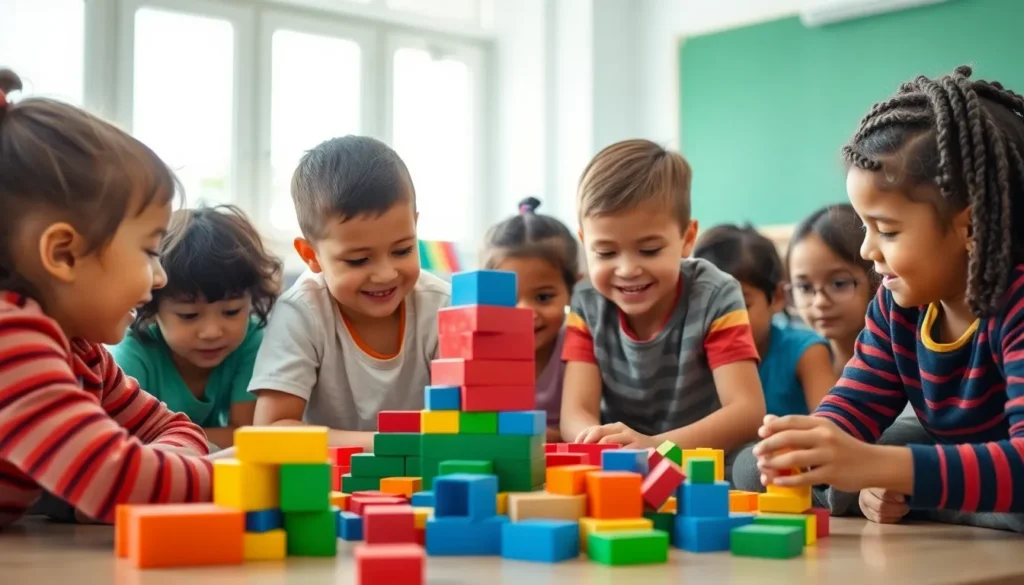
Block play learning offers a wealth of advantages for children’s development. This engaging educational tool not only sparks creativity but also nurtures critical skills essential for growth.
Cognitive Development
Cognitive development flourishes through block play. Children actively engage in problem-solving by experimenting with different block structures. As they build, they also strengthen their spatial awareness and gain an understanding of balance and gravity. Learning concepts like symmetry and pattern recognition happens naturally during play. They develop mathematical skills, such as counting and measuring, while manipulating blocks of various sizes. Observing their actions, parents and educators can assess developmental milestones, noting how children conceptualize space and design structures. Block play serves as a foundation for future academic pursuits in science, technology, engineering, and mathematics (STEM).
Social Skills Enhancement
Social skills enhance significantly through collaborative block play. Children work together, sharing ideas and negotiating roles. They learn effective communication techniques and build teamwork skills while creating shared structures. Conflict resolution becomes a natural part of the process, as they navigate disagreements during play. Many children practice empathy by considering their peers’ perspectives and acknowledging different ideas. Such interactions foster friendship and trust among players. Observing these dynamics provides valuable insights into children’s social development, revealing how they interact with others and adapt to collaborative environments. Block play not only entertains but also cultivates essential social competencies needed for future relationships.
Types of Block Play Activities
Block play activities can be categorized into two main types: structured play and unstructured play. Each type offers unique benefits and opportunities for children to develop important skills.
Structured Play
Structured play involves specific goals and activities designed by adults, providing clear instructions for children. Examples include following building instructions, creating specific structures, or completing challenges that require specific designs. Engaging in structured play helps children understand concepts such as balance, symmetry, and measurement, reinforcing their math skills. These focused activities also foster teamwork and communication, as children collaborate to achieve their objectives. With guidance from teachers or parents, children learn to problem-solve by figuring out how to achieve the desired outcomes effectively.
Unstructured Play
Unstructured play allows children the freedom to explore creativity without predefined goals. Children can build anything they imagine, from castles to bridges, using blocks in unique ways. Through this open-ended play, they develop critical thinking and spatial awareness as they experiment with designs. Unstructured play also encourages social interactions, as children negotiate and share ideas with peers. This spontaneous and imaginative approach promotes independence, allowing children to take risks and learn from trial and error. As they interact during unstructured play, children not only enhance their cognitive skills but also develop emotional intelligence, fostering essential social connections.
Implementing Block Play in Educational Settings
Block play can thrive in various educational settings, encouraging children’s development. Through intentional strategies and thoughtful adaptations, educators and parents can create optimal environments for block play.
Classroom Strategies
Incorporating block play in the classroom fosters engagement and creativity. Start by designating a specific area for block play, ensuring ample space for movement and exploration. Provide diverse block types, including wooden, foam, and magnetic blocks, to stimulate creativity and problem-solving. Encourage collaborative projects where small groups build structures together, enhancing teamwork and communication skills. Integrate block play with lesson plans, connecting mathematics and science concepts to activities like building bridges or towers. Observe children’s progress, using their interactions and creations to guide future lessons and support individual growth.
Home Environment Adaptations
Adapting the home environment for block play significantly benefits children’s learning experiences. Set up a dedicated play area with easy access to blocks of various shapes and sizes. Parents can join in the play, initiating conversations about balance, symmetry, and measurement through hands-on experiences. Rotate block types regularly to maintain interest and challenge children’s creativity. Creating themed play sessions, such as architectural designs or imaginative cities, inspires deeper exploration. Document children’s progress and designs, reinforcing their achievements and encouraging reflection on their building processes.
Conclusion
Block play learning stands out as a powerful educational method that nurtures essential skills in children. By engaging in both structured and unstructured play, kids not only learn mathematical concepts but also enhance their creativity and social abilities. This dynamic form of play encourages exploration and experimentation, making learning both enjoyable and impactful.
Integrating block play into daily routines fosters a rich environment for cognitive and emotional growth. As children build and collaborate, they develop problem-solving skills and strengthen their ability to communicate effectively. The insights gained from observing block play interactions can guide parents and educators in supporting each child’s unique developmental journey. Embracing block play as a vital educational tool can significantly enrich children’s learning experiences and prepare them for future success.